Beethoven Violin Sonatas Nos. 4 & 5
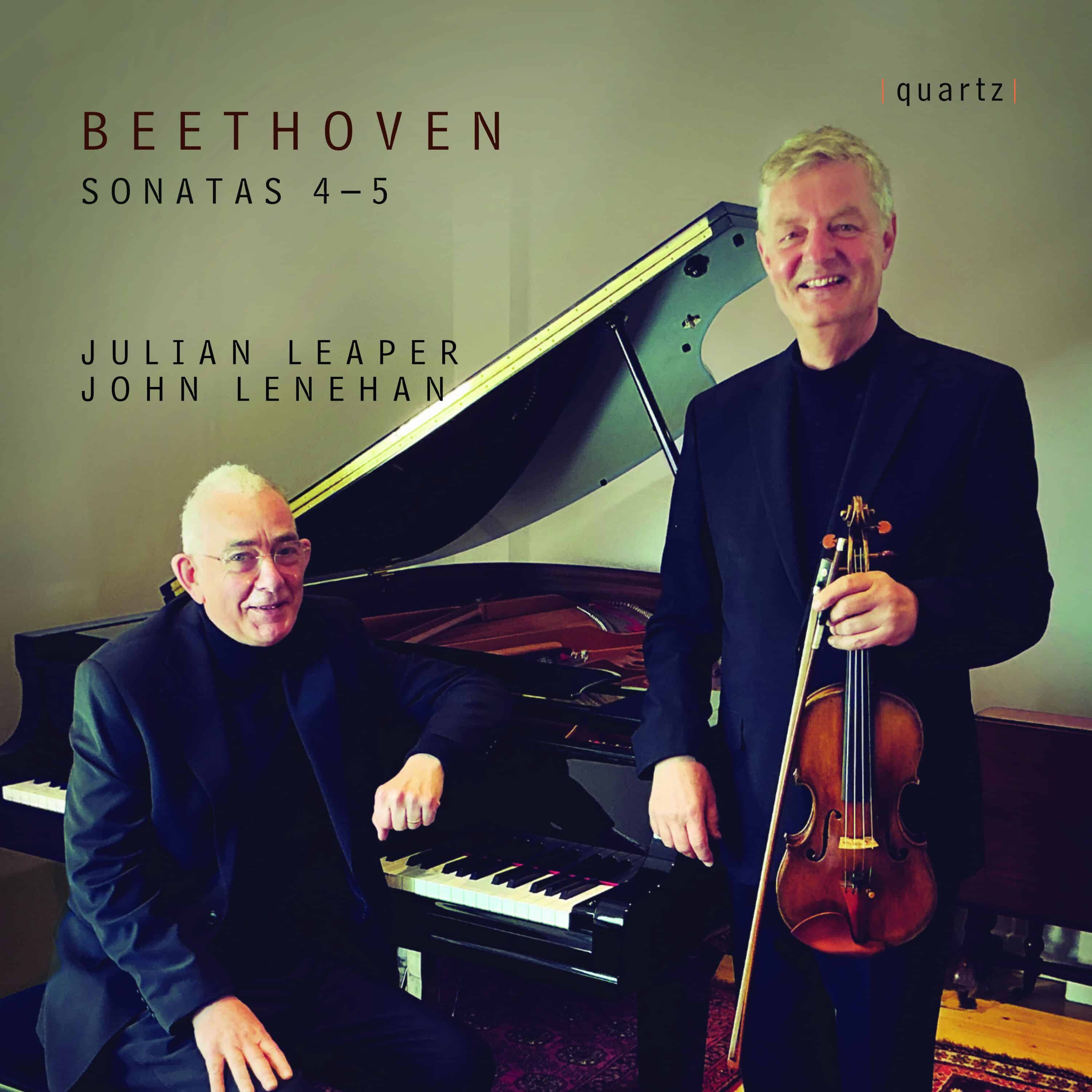
Price range: £7.99 through £16.99
Most of Beethoven’s ten violin sonatas were composed within a time span of no more than 6 years (1797-1803), with the exception of the last one, op. 96, which he began in 1812, taking probably a further 3 years to revise to his satisfaction. This means the set as a whole represents a relatively young Beethoven, though his development from the early Op. 12 sonatas to the “Kreutzer” Op. 47 clearly demonstrates a formidable inner creative force. His cello sonatas, string quartets and symphonies are more evenly spaced throughout his life, but the violin sonatas lack nothing in invention, range of expression and feeling. As so often in Beethoven’s early works the intensity of the slow movements stands out. This is Volume 2 of Julian Leaper recordings of Complete Violin Sonatas.
About This Recording
Most of Beethoven’s ten violin sonatas were composed within a time span of no more than six years (1797–1803), with the exception of the last one, Op.96, which he began in 1812, taking probably a further three years to revise to his satisfaction. This means the set as a whole represents a relatively young Beethoven, though his development from the early Op.12 sonatas to the “Kreutzer” Op.47 clearly demonstrates a formidable inner creative force. His cello sonatas, string quartets and symphonies are more evenly spaced throughout his life, but the violin sonatas lack nothing in invention, range of expression and feeling. As so often in Beethoven’s early works the intensity of the slow movements stands out.
When Beethoven arrived in Vienna from Bonn in November 1792, he was still only 21 and had yet to build a reputation and a life. He began by giving concerts in the aristocratic salons of Vienna, with improvisations included in his programmes. Before embarking on the violin sonatas he composed Variations for piano and violin on Mozart’s Se vuol ballare from The Marriage of Figaro, dedicated to his former pupil and friend, Eleonore von Breuning. He provided her with a little background to the work, and to his progress in Vienna, in a letter written exactly one year after he had left Bonn.
“Vienna, 2nd November 1793. The Variations are rather difficult to play, especially the trills in the Coda, but don’t be alarmed, it is constructed so that you need play only the trills, leaving out the other notes, which are also in the violin part. I would never have written anything like that had I not often noticed how some people in Vienna, after hearing me improvise one evening, would copy several peculiarities of my style the next day and proudly claim them as their own. Well, as I foresaw that their pieces would soon be published; I resolved to forestall these people. However, there was another reason, too; my desire to embarrass the top pianists here, some of whom are my sworn enemies. I wanted to take my revenge on them in this way, because I already knew that my variations would before long be set before the gentlemen and they would make a mess of them.”
Like Mozart, he was not only an outstanding pianist but also played the violin and viola. It seems more than probable he met Mozart in an earlier visit to Vienna in 1787, which was unfortunately cut short by the news that his mother was gravely ill, forcing a hasty return to Bonn.
All the violin sonatas bear dedications, the Op.12 to Salieri, who helped him after his arrival in Vienna, the others, apart from the Kreutzer, to aristocratic patrons on whom he depended for a living. Making a career as a freelance musician without a court or church appointment was never easy, not then and not now. Beethoven’s increasing deafness would gradually deprive him of the opportunity to play concerts but, in compensation, his ever-growing reputation as a composer was able to provide him with an income. His letters reveal how much time and effort was invested in negotiating prices for his compositions and running his ‘business’.
In the tradition of the time these are sonatas for piano with the addition of a violin, but no violinist would regard the violin part as in any way subsidiary or merely an accompaniment to the piano. Musical and technical challenges are shared equally and these seminal works remain at the heart of the repertoire of both violinists and pianists.
Violin Sonata No.4 in A minor Op.23
i Presto
ii Andante scherzoso, più allegretto
iii Allegro molto
Unlike the Op.12 and Op.30 sets, each containing three sonatas, Beethoven’s Op.23 and Op.24 were published as individual sonatas. Although both were written in the years 1800/01 they are strongly contrasted works. The first movement of Op.23 is an agitated Presto in 6/8 time, which one might normally expect to see in a Finale, but the character of the music sits well in an opening movement. It is in sonata form, but rich in contrapuntal material and driven in tempo. With hardly time to catch his breath the brave listener then encounters a movement so charming, so delightful and so unexpectedly scherzoso it takes his breath away! For the second subject Beethoven adds a sprinkling of pure, tongue-in-cheek impudence. This is not a quality normally associated with his music, but if he set out to prove he can do it, he certainly succeeded. The rondo Finale returns to ‘business as usual’. The tempo is quick and the ideas come thick and fast. Episodes of varying length appear and there is room for some development in the coda before the music floats down for a soft landing.
Violin Sonata No.5 in F Major “Spring” Op.24
i Allegro
ii Adagio molto espressivo
iii Scherzo (Allegro molto)
iv Rondo (Allegro ma non troppo)
How this sonata acquired the nickname ‘Spring’ seems lost in the mists of history, but most would agree that, although the culprit was not Beethoven, it faithfully reflects the gentle, fresh breeze emanating from its opening theme. ‘Named’ music is often particularly popular and this sonata is probably the most frequently performed of them all. There is much contrasting music in the course of the first movement, especially in the development section with its agitated triplets, and it is a relief to arrive safely back on home ground at the recapitulation.
The fine-spun, unhurried melody of the slow movement, heard first in the piano and subsequently in the violin, heralds a movement of deep beauty, it is sufficiently spacious to permit delicate, filigree ornamentation. The Scherzo which follows must surely be one of Beethoven’s shortest and most pithy. Here and there the violin breaks ranks and is heard in hot pursuit of the piano after missing a beat, but it all works out for the best in the best of all possible worlds, Beethoven’s world!
The fourth movement, combining elements of sonata and rondo form, recaptures some of the lyricism of the opening movement. A dramatic development section leads to a surprise recapitulation in the wrong key of D major, but Beethoven has his hand on the gear lever and skilfully returns the music to the home key. As so often in Beethoven, the coda is treated as an extension of the development section and an opportunity to introduce further ideas. This time, however, Beethoven is impatient to be finished and the work is peremptorily dismissed.
Track Listing
- I. Presto (8:21)
- II. Andante scherzoso, più allegretto (8:02)
- III. Allegro Molto (6:04)
- I. Allegro (10:07)
- II. Adagio molto espressivo (4:56)
- III. Scherzo. Allegro molto (1:20)
- IV. Rondo. Allegro ma non troppo (7:08)
You may also like…
Beethoven: Violin Sonatas Nos 1–3
Price range: £7.99 through £16.99 Select options This product has multiple variants. The options may be chosen on the product pageRelated products
LifeMusic
Price range: £4.99 through £11.99 Select options This product has multiple variants. The options may be chosen on the product page
Alfred Schnittke – Works for Violin and Piano
Price range: £5.99 through £11.99 Select options This product has multiple variants. The options may be chosen on the product page
Elgar – The Apostles
Price range: £4.99 through £13.99 Select options This product has multiple variants. The options may be chosen on the product page