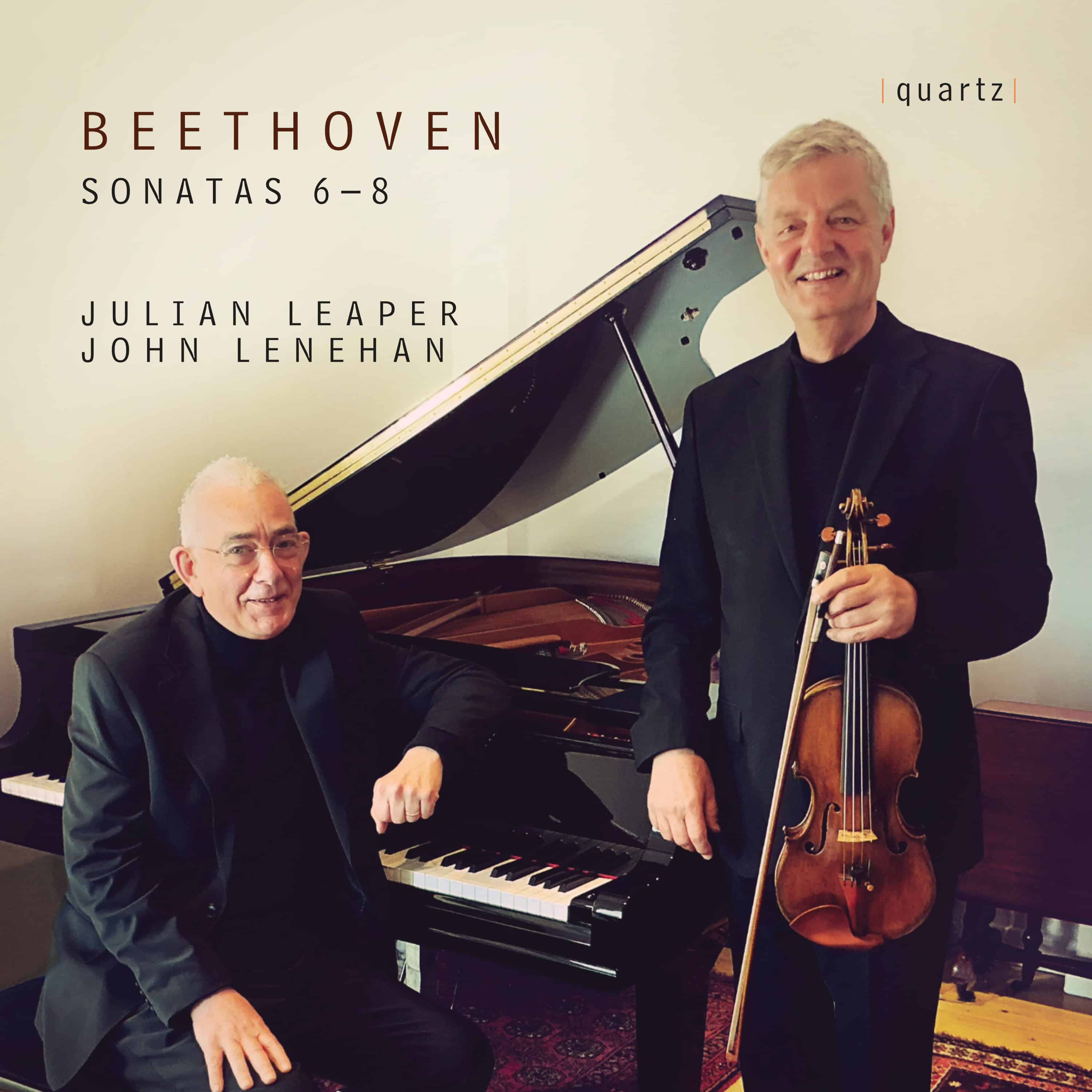
Most of Beethoven’s ten violin sonatas were composed within a time span of no more than six years (1797–1803), with the exception of the last one, Op.96, which he began in 1812, taking probably a further three years to revise to his satisfaction. This means the set as a whole represents a relatively young Beethoven, though his development from the early Op.12 sonatas to the “Kreutzer” Op.47 clearly demonstrates a formidable inner creative force. His cello sonatas, string quartets and symphonies are more evenly spaced throughout his life, but the violin sonatas lack nothing in invention, range of expression and feeling. As so often in Beethoven’s early works the intensity of the slow movements stands out.
When Beethoven arrived in Vienna from Bonn in November 1792, he was still only 21 and had yet to build a reputation and a life. He began by giving concerts in the aristocratic salons of Vienna, with improvisations included in his programmes. Before embarking on the violin sonatas he composed Variations for piano and violin on Mozart’s Se vuol ballare from The Marriage of Figaro, dedicated to his former pupil and friend, Eleonore von Breuning. He provided her with a little background to the work, and to his progress in Vienna, in a letter written exactly one year after he had left Bonn.
“Vienna, 2nd November 1793. The Variations are rather difficult to play, especially the trills in the Coda, but don’t be alarmed, it is constructed so that you need play only the trills, leaving out the other notes, which are also in the violin part. I would never have written anything like that had I not often noticed how some people in Vienna, after hearing me improvise one evening, would copy several peculiarities of my style the next day and proudly claim them as their own. Well, as I foresaw that their pieces would soon be published; I resolved to forestall these people. However, there was another reason, too; my desire to embarrass the top pianists here, some of whom are my sworn enemies. I wanted to take my revenge on them in this way, because I already knew that my variations would before long be set before the gentlemen and they would make a mess of them.”
Like Mozart, he was not only an outstanding pianist but also played the violin and viola. It seems more than probable he met Mozart in an earlier visit to Vienna in 1787, which was unfortunately cut short by the news that his mother was gravely ill, forcing a hasty return to Bonn.
All the violin sonatas bear dedications, the Op.12 to Salieri, who helped him after his arrival in Vienna, the others, apart from the Kreutzer, to aristocratic patrons on whom he depended for a living. Making a career as a freelance musician without a court or church appointment was never easy, not then and not now. Beethoven’s increasing deafness would gradually deprive him of the opportunity to play concerts but, in compensation, his ever-growing reputation as a composer was able to provide him with an income. His letters reveal how much time and effort was invested in negotiating prices for his compositions and running his ‘business’.
In the tradition of the time these are sonatas for piano with the addition of a violin, but no violinist would regard the violin part as in any way subsidiary or merely an accompaniment to the piano. Musical and technical challenges are shared equally and these seminal works remain at the heart of the repertoire of both violinists and pianists.