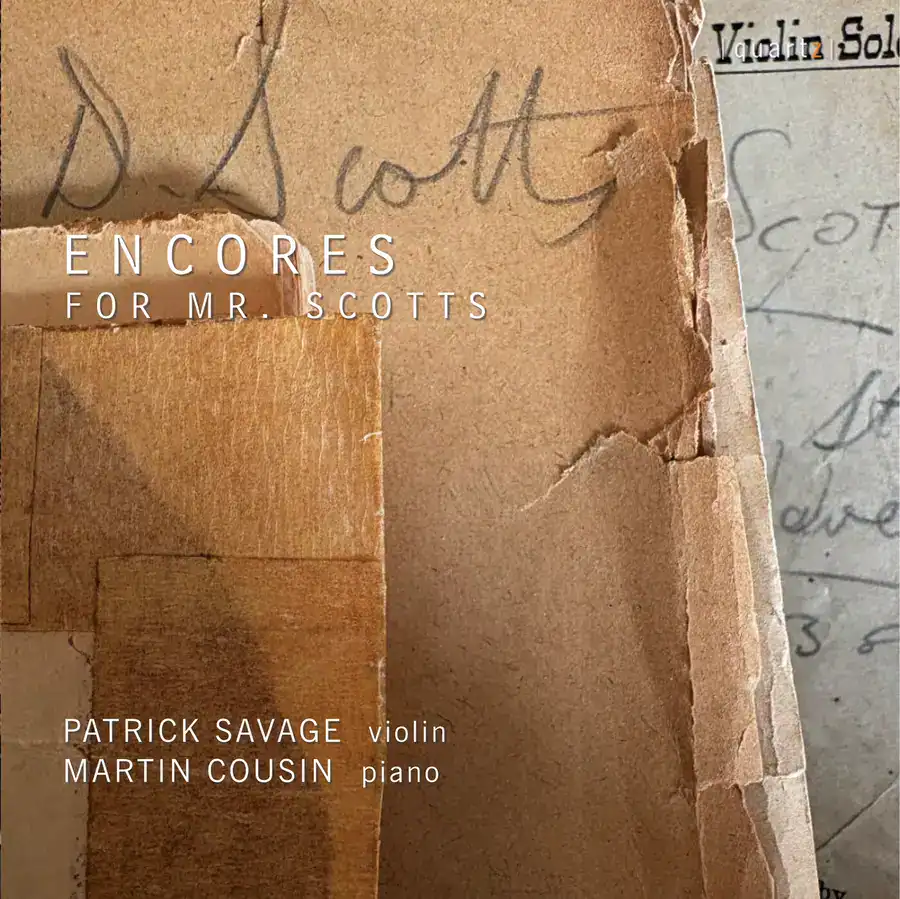
Encores for Mr. Scotts
Price range: £7.99 through £16.99
About This Recording
This album is a celebration of a great Australian gentleman of the violin, Donald Scotts.
Don was a star of his generation – Associate Concertmaster of the Melbourne Symphony Orchestra, leader of the Melbourne String Quartet, and a soloist of rare gifts. And to me, he was Mr Scotts – my beloved violin teacher of twelve years.
From the age of 6, I’d make the two-hour train journey down to Melbourne for my lesson with Mr Scotts, and he’d welcome me to his office like a long-lost grandson.
Mr Scotts was a joyful force of nature. Possessed with irrepressible, youthful energy and a zest for life, he was a masterly raconteur with a great stash of stories and only the goofiest jokes, and he cared for his students like family.
When I played well, he’d jubilantly declare, “BEST YET!”, which became a catchphrase in our household. Equally legendary was his singing in lessons, when every phrase of Handel or Tchaikovsky became a husky, “Doo be doo be doo” – he was a Sinatra fan after all.
But when he’d take his Landolfi violin under his chin to demonstrate, it was spellbinding – his gloriously warm, generous tone, his nobility of manner, his easy, Kreislerian charm.
Mr Scotts’ lessons made me love playing the violin.
On a visit from the UK to Australia in 2023, almost 30 years after our final violin lesson, I made the drive to Don’s care home, down by the sea in Rosebud, to play a little concert for him. It was made possible thanks to the kind efforts of his family, who took the most loving care of him until the very end of his life.
With the brilliant Konrad Olszewski on piano, our programme that morning was Tempo Di Minuetto, Variations on a Theme of Corelli, and Liebesleid – all works that Don had taught me and that he loved, and all now featuring on this album.
After so many years, it was nerve-wracking to play for my teacher again, but afterwards he was as gracious and effusive in his praise as ever.
Then, in a deeply moving gesture for which I was entirely unprepared, he presented me with the beautiful instrument and bow that he’d played as a student, and a box containing his precious sheet music library.
It’s from Don’s library, collected over his long life in music, that the pieces on this album are drawn.
As his student, I’d had a long acquaintance with his music collection. Those magnificently tattered, browned and fragile documents had long been a source of fascination, resembling ancient parchments from lost civilisations. He’d often tell of the miraculous survival of the music, fished out from beneath the house during the terrible flood. Newly printed violin parts on bleached white paper never had the same aura.
–Patrick Savage
The music library
Many albums could have been assembled from the treasures in this eclectic collection, but encore pieces seemed an obvious choice – Don delighted in miniature masterworks, with a natural affinity for Kreisler in particular.
My aim in this album was to compile a set of pieces that represented Don as I remembered him – to try and conjure something of his sparkle and charm, and his mischievous, gentle sense of humour.
Don had always taken special pleasure in Kreisler’s elegant Spanish arrangements, so Danse Espagnole by Manuel de Falla, Glazunov’s Serenade Espagnole, and, most beloved of all, Chaminade’s Serenade Espagnole, were essential choices.
Manuel de Falla’s Jota, from 7 Canciones Populares Españolas, arranged by Paul Cochanski, was a piece that Don prepared with me for my first public recital. I associate this music with his pep-talk by the stage: you’ve done the preparation – you have nothing at all to fear – you’re ready. I do believe he was as nervous as I was, but his words were reassuring and I’ve often repeated this pre-concert mantra to myself.
Kreisler’s exquisite arrangement of Ede Poldini’s Dancing Doll, Ottokar Novacek’s brilliantly fiery Perpetuum Mobile, and the stirring Cavatina, by Joachim Raff, were all staples of those years with Don, and of his own recital repertoire.
Some selections from his library are on this album simply because he would have played them masterfully: the delightfully unhinged La Capricciosa, by Franz Ries, Vasa Prihoda’s virtuosic arrangement of the waltzes from Richard Strauss’s opera, Der Rosenkavalier, Souvenir de Vienne by Heinz Provost, Romanza by Lorenzo Camilieri, Valse Staccato by Josef Piastro-Borisoff and the magnificently fun and irreverent Two Minutes Jazz by the Czech violinist, Karel Jan Zoubek. Several of these are rarities – particularly the Camilieri which was previously unrecorded. Don took pride in introducing audiences to new works, so he would have approved of these little-known gems in this lineup.
The ethereal Zephyrs, from the Australian composer Alfred Hill, and Gerald Walenn’s cheerful little Humoresque from Six Pièces Faciles were two such rarely-played pieces which Don introduced to me early in my studies. They were particular favourites of his.
The final piece on this album, Ernest Moeran’s song, Mantle of Blue, is the exception in this tracklist, in that it wasn’t found in Don’s sheet music collection. This song is included as a tribute to his glorious recordings of Moeran’s music. Don made Moeran’s E minor Sonata his own, and his wonderful recording, with John Talbot at the piano, must be heard.
Mantle of Blue was Moeran’s setting of Padraic Colum’s 1907 poem, A Cradle Song. It’s a song of mourning, but the musical setting and the words are as gentle and as lovely as they could be, and it’s a melody I would have loved to have heard him play.
A Cradle Song — Padraic Colum (1907)
O men from the fields,
Come gently within.
Tread softly, softly
O men coming in!Mavourneen is going
From me and from you,
Where Mary will fold him
With mantle of blue!From reek of the smoke
And cold of the floor
And the peering of things
Across the half-door.O men of the fields,
Soft, softly come thro’
Mary puts round him
Her mantle of blue.
With his immense kindness, generosity and his love for life, Don’s greatness of spirit shone through in his playing and his teaching. He was an example and an inspiration. It was an honour to be his student and I will always have love and gratitude for him.
He is so greatly missed.
With thanks to: Ira Apekisheva, Jane Goode, Andrew Scotts, Helen Scotts, David Scotts, Elizabeth Paterson, Lauren Smith, Adrian Green, Konrad Olszewski, the staff at Village Glen in Rosebud, Chris Hatt, Greta Mutlu and Jose Gabriel Ferrer-Aza.
And a special thank you to my parents for taking me to my lessons when I was too small to go on my own.
Donald Scotts
written by his children: Jane Goode, Andrew Scotts, Helen Scotts, David Scotts, and Elizabeth Paterson
Our father lived a life rich in music, family, humour, and faith. A renowned violinist, his journey began with early lessons in primary school before earning scholarships to Waverley College and the Sydney Conservatorium. From there, his extraordinary talent carried him around Australia and onto the world stage, performing at intimate chamber music venues and in great concert halls including the Sydney Opera House and Carnegie Hall and leading orchestras with distinction. He was admired as a consummate musician – expressive, dedicated, and completely at home in his art.
At the heart of his life was his love for his wife, Veronica, and his deep devotion to the Catholic faith, which quietly grounded him throughout everything he did. Together they built a family of five children, and his greatest joy was always found at home with them. Their family extended over the years to include nine grandchildren and eight great grandchildren.
To his family, he was never just a musician of international standing – he was Dad. Life with him was full of humour, stories, and small rituals that became treasured memories: beach holidays at Mermaid Beach, Sunday drives to the Dandenongs or Mornington Peninsula, family barbecues and picnics with the “old blue casserole” and his famous portable wood-fired BBQ. He had a gift for making the simple things feel special.
Music was always present in our home. We remember the sound of him practising, the excitement after concerts as he “basked in the afterglow,” and his generous way of sharing his love of music and words. He was also a gifted teacher and mentor, and many pupils came through the family home for lessons.
He was warm, funny, and endlessly engaging. His humour – his corny Dad jokes, antics, and sayings – has carried through generations. He loved reading, jazz music and sport, especially his beloved Melbourne Demons, and could just as easily enjoy a pie at lunch as a night at a concert hall.
Above all, he was a man who loved deeply and lived fully. Even in later life, he remained optimistic, invariably greeting inquiries about how he was feeling with a cheerful “absolutely fantastic”. His legacy lives on in his music, his faith, and most importantly, in the family he adored.
He will be missed beyond words, but always remembered with love.
Track Listing
- Franz Ries: La Capricciosa (4:15)
- Manuel de Falla: Danse espagnole (Arr. Kreisler) (3:47)
- Joachim Raff: Cavatina for Violin & Piano, Op. 83 No. 3 (3:56)
- Richard Strauss: Der Rosenkavalier, Op. 59, TrV 227: Der Rosenkavalier Waltzer (7:16)
- Fritz Kreisler: Tempo di minuetto in the Style of Pugnani (3:53)
- Alfred Hill: Zephyrs (3:48)
- Fritz Kreisler: Variations on a Theme by Corelli (in the style of Tartini) (3:46)
- Manuel de Falla: 7 Canciones populares españolas: No. 4, Jota (Arr. Paul Kochanski) (2:54)
- Ede Poldini: Marionettes: No. 2, La poupée valsante (Arr. Kreisler) (2:38)
- Ottokar Novácek: Concert Caprices, Op. 5: No. 4, Perpetuum mobile (2:51)
- Fritz Kreisler: 3 Old Viennese Dances: No. 2, Liebesleid (3:27)
- Gerald Walenn: Humoresque (1:10)
- Heinz Provost: Intermezzo “Souvenir de Vienne” (3:30)
- Alexander Glazunov: 2 Pieces for Cello & Orchestra, Op. 20: No. 2, Sérénade espagnole (Arr. Kreisler) (3:10)
- Lorenzo Camilieri: Romanza (2:34)
- Jean Henri Ravina: 25 Études mignonnes, Op. 60: No. 3, Valse staccato (Arr. Josef Piastro-Borissof)
- Cécile Chaminade: Sérénade espagnole, Op. 150 (Arr. Kreisler)
- Karel Jan Zoubek: Two Minutes Jazz (2:54)
- Ernest Moeran: Mantle of Blue (1:56)
Related products
Gershwin: New York Connections
Price range: £4.99 through £11.99 Select options This product has multiple variants. The options may be chosen on the product page
Alfred Schnittke – Works for Violin and Piano
Price range: £5.99 through £11.99 Select options This product has multiple variants. The options may be chosen on the product page
Elgar – The Apostles
Price range: £4.99 through £13.99 Select options This product has multiple variants. The options may be chosen on the product page