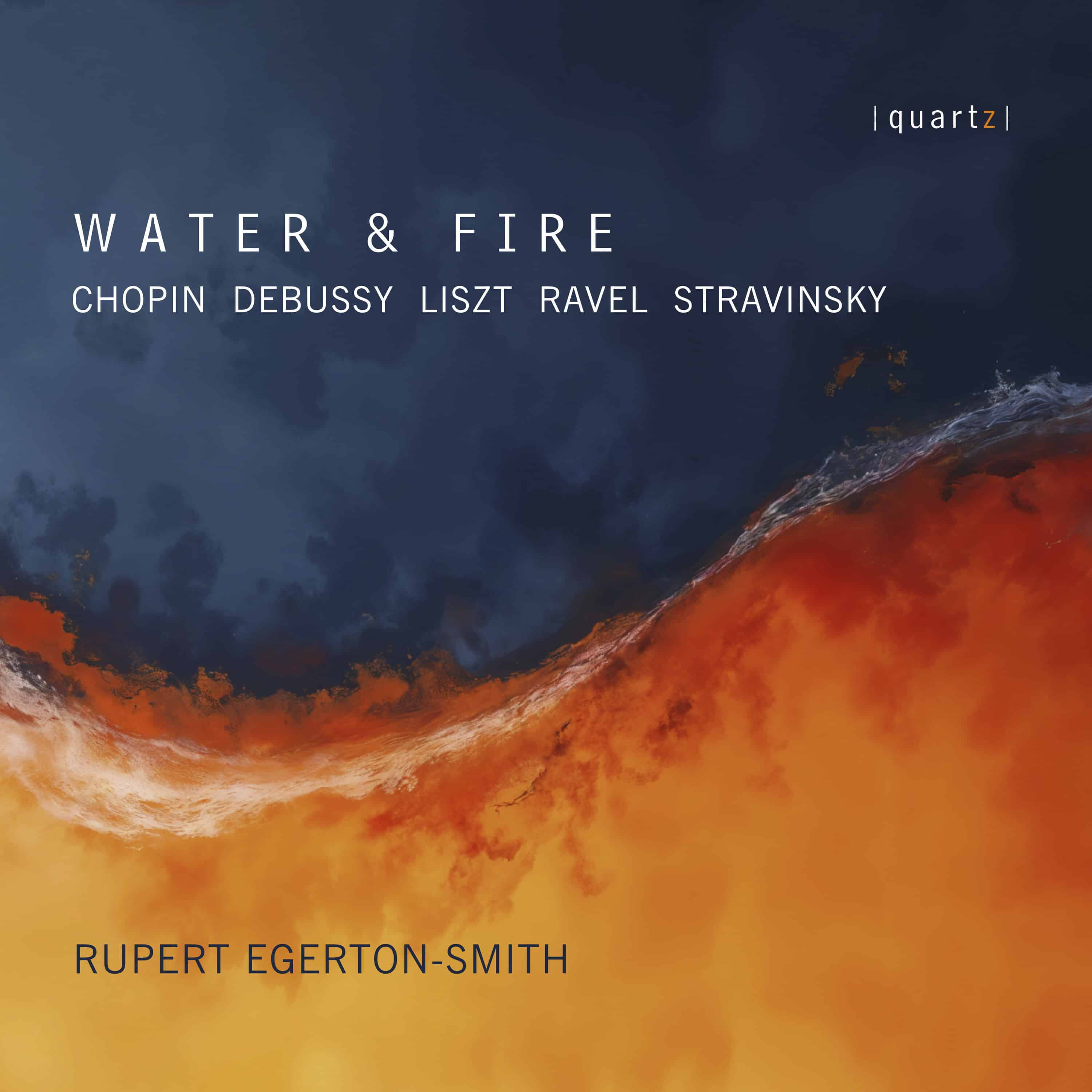
I have always been fascinated by the role of music in storytelling and how composers can conjure up atmospheres and environments through their harmonic and melodic choices, orchestral textures and use of colour. With so much wonderful piano music to play, I am also passionate about finding a narrative map through this vast landscape and bringing together works for audiences around a theme, often juxtaposing pieces seldom performed, or rarely programmed together. These interests formed the genesis to Water & Fire, a virtuosic journey through the Elements which illustrates the intrinsic relationship between visual and musical imagery. The music ranges from the shimmering sparkle of fountains and the ripple of waves to the crackle of flame and fireworks, each piece in the programme coalescing around the overall narrative whilst having its own very distinct story and entailing some precise music treatment.
There was no better place to start the programme than in impressionist territory, rich in its powerful cinematic scope. Both Ravel and Debussy had a strong affinity with the sea and with water, Debussy describing music as “the expression of the movement of the waters” and Ravel growing up near the sea at Saint-Jean-de-Luz. Ravel’s Jeux d’eau (1901) is a watery world of sparkling fountains, ripples and light catching on the crests, a depiction of water at its most effervescent and sensuous. The piece was written at a time that piano music was shifting from German Romantic heaviness towards colour, clarity and atmosphere and Ravel presents a shimmering sound world of arpeggios, rapid hand-crossings and delicate harmonies. He dedicated the work to his teacher Gabriel Fauré and he writing at the top of the score a credit to the symbolist poet Henri de Régnier Dieu fluvial riant de l’eau qui le chatouille (“A river god laughing as the water tickles him”). Ravel openly acknowledged Liszt’s Jeux d’eau a la Villa D’Este as a model and Debussy had written his Reflets dans l’eau (from Images) at around the same time, perhaps hinting at some compositional rivalry.
Whilst Ravel seeks to create a sensation of water as motion and pleasure, Debussy in his La Cathédrale Engloutie (The Sunken Cathedral) (1910) explores the notion of water as depth, weight and memory. The work is inspired by an ancient Breton legend in which a cathedral submerged off the island of Ys appears to rise out of the water when translucent. Debussy meticulously choreographs the visual scene writing at one point in the piano score “as if rising out of the fog”. We hear the choirs in the piano, the chiming of cathedrals bells and as the building rises out of the water, the thundering organ conveyed through massive chords. The piece comprises an astonishing musical arc as the Cathedral emerges from and ultimately recedes under the waves. Debussy’s preoccupation here is not sparkle but rather mass and distance, how sound travels through water and stone. It is an incredible transformation of a visual image into a musical one.
After these two important impressionist pieces and before the virtuosity of the Liszt, I wanted the listener to experience a moment of calm. I felt the camera move through the ocean mist to reveal a lone swan gliding across the surface of a still lake in Le Cygne by Camille Saint-Saëns, taken from The Carnival of the Animals (1886). The pianist Leopold Godowsky’s transcription replaces Saint-Saëns’ cello line with a singing right-hand cantabile, the flowing piano accompaniment carefully voiced never to disturb the surface calm. This piece closes the French segment in a mood of serenity and reflection.
In the 1850s Franz Liszt’s religious sensibility deepened following personal tragedy and somewhat of a retreat from the more flamboyant virtuoso lifestyle he had enjoyed. In 1865 he even took up minor holy orders, becoming Abbé Liszt. The Deux Légendes composed in 1863 should therefore be seen in this more introspective context as Liszt became more focused on exploring meaning in his composition – suffering, silence, faith – rather than demonstrating brilliance and piano pyrotechnics. The Légendes are consequently more contemplative and spiritual in nature, almost composed acts of meditation, and were important influences to composers such as Debussy, Messiaen, and later sacred modernists.
In the second Légend performed here, Liszt was inspired by a painting he owned which depicted the legend of St. Francis of Paola who was refused passage to Sicily by a boatman and set out to walk over the water across the Strait of Messina. Liszt wrote of his excitement about the painting to Richard Wagner in 1860, “on his outspread cloak he strides firmly, steadfastly, over the tumultuous waves – his left hand holding burning coals, his right hand giving the sign of blessing, his gaze directed upwards”.
The work is a masterpiece in its ability to portray a psychological portrait of the struggle and triumph of the human spirit against inestimable odds and runs the full gamut of emotions from anxiety and fear to a sense of glorious achievement and triumph. The sound world is dark, turbulent, almost orchestral as the rolling tremolos in the left hand resemble waves, rising harmonies conjure unwavering belief and a clear ‘miracle’ moment is heard as the storm parts, and the St Francis theme is played in its full glory. Finally, in the coda to the piece, we almost feel St Francis looking back at his incredible achievement and celebrating the resilience and transcendence of the soul in an exalted experience. The piece is particularly resonant as, with the context, it almost feels like a personal metaphor, a man who had known fame, chaos and temptation trying to walk above the waves through faith and discipline.
Another major and late work in the composer’s catalogue, Chopin’s Barcarolle Op.60 was written in 1845-46. Traditionally a barcarolle is a Venetian boating song in lilting 6/8 or 12/8, the gentle rocking rhythm representing the boat’s motion in the water. Chopin maintains the gentle sway but turns this into a much more ambitious project, again highly visual. We can envisage a pair of lovers being swept gracefully through Venetian canals, a placid nocturnal scene, before the passion and ornamentation grows and the piece finally reaches a blazing climax, perhaps as the boat reaches open water and both the lagoon and the lovers’ interactions become more turbulent and intense. This is a long work by Chopin’s standards, a ‘single take’ with no sharp breaks as, like the water, everything flows seamlessly. The piece feels improvised but is carefully structured by Chopin and is harmonically very advanced with long-spun chromatic lines and daring modulations that still feel inevitable. Apparently, Liszt very much-admired Chopin’s Barcarolle.
Manuel De Falla’s Ritual Fire Dance ignites the Fire section of the recital. This piece is the composer’s own piano transcription of a movement from his ballet El amor brujo (The Bewitched Love) written in 1915. In the story, a young Andalusian gypsy girl called Candela is haunted by the ghost of her dead husband. To expunge the memory, all the gypsies make a large circle around their campfire at midnight, and Candela then performs the Ritual Fire Dance. This causes the ghost to appear, with whom she then dances. As they whirl around faster and faster, the ghost is enticed into the flames, making it vanish forever. The piece has a feverish energy, its fast repetitive trills and percussive rhythms carrying the dance to an incendiary climax.
Feux d’artifice (Fireworks) is Debussy’s last prelude from Préludes, Book II (1913). The contrast in cinematography to La Cathédrale Engloutie could not be greater. We hear the pop and whizz of rockets from rapid hand flickers and trills, bursts in the sky represented by sudden loud chords, all set against the festive celebration of Bastille Day. There is a feeling of exhilaration in this piece as a listener and a performer, the unpredictability and shock of explosions a feast for the senses. In characteristic Debussy style in the final lines, we can hear the distant call of La Marseillaise floating on the wind as the smoke lingers.
The final major work in the programme intensifies the musical heat still further. The Italian pianist Guido Agosti transcribed Stravinsky’s The Firebird Suite (1910) into three movements in 1928. Prince Ivan captures a magic feather from a Firebird, a lifeline if he is ever in danger. As he wanders through forbidden lands, he meets a group of enchanted princesses trapped by the evil King Kashchei. Ivan falls in love with one of them, but he is captured by Kashchei who threatens to turn him to stone (The Infernal Dance). Ivan remembers the feather and summons the Firebird who puts the king and his evil knights to sleep (the Berceuse). This enables Ivan to smash an egg containing Kashchei’s immortal soul, the spell breaks, the princesses are freed and Ivan is united with his princess. The Firebird disappears as dawn rises, magic is fulfilled and balance returns to the lands (Finale). Agosti’s version is really a recomposition of Stravinsky’s work for piano, orchestral in its scale and structure, richly layered and textured, combining relentless octaves, brutal chord clusters and lightning-fast leaps. As a pianist there is no place to hide as once the piece starts, the pianist is in the flames, in both a nerve-shredding and glorious performing experience. If Debussy’s Fireworks represents shimmering light and gunpowder in the sky, Agosti’s Firebird is the ground catching fire, scorched earth under the Infernal Dance. Agosti creates a remarkable orchestral illusion as he somehow manages to make one piano sound like a full ballet orchestra.
After the programme’s climax I wanted to bring the vibrancy and adrenalin levels down and re-orient the programme. I adore Rachmaninov’s music and also Earl Wild’s amazing transcriptions. Where Beauty Dwells re-imagines the delicate, lyrical melody of one of Rachmaninov’s most famous songs as a rich and romantic piano piece gently rendered but lushly scored. Closing out the recording, I included a live improvisation taken in the final minutes of the session, a retrospective epilogue to this exploration of piano music inspired by the Elements of Water & Fire.
Rupert Egerton-Smith February 2026